Val di Funes Travel & Photography Guide: How to Experience the Dolomites Without the Crowds
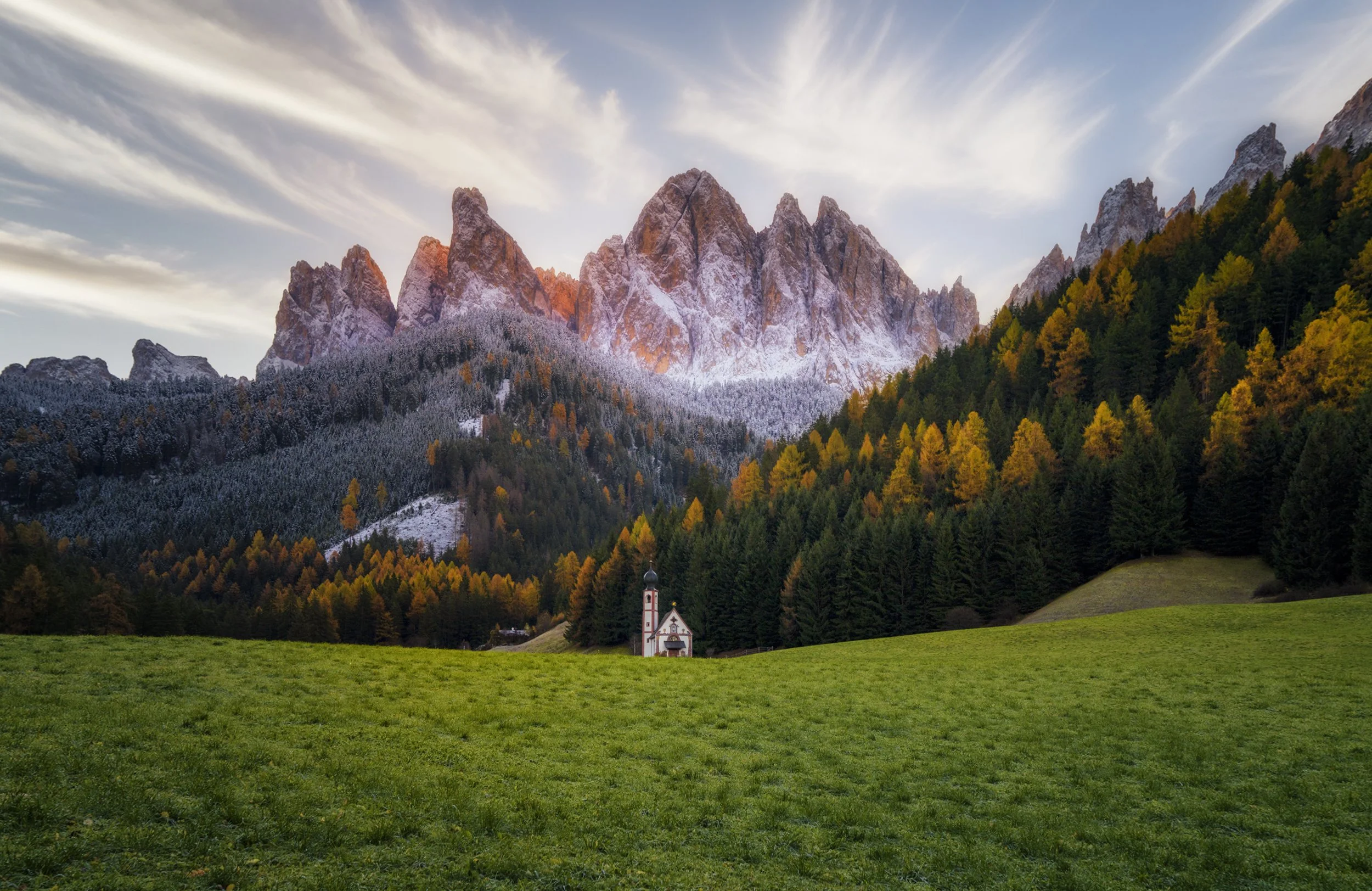
Autumn meets winter in Val di Funes as fresh snow covers the Odle mountains above San Giovanni in Ranui.
There are places you visit once, photograph and move on from.
Val di Funes isn’t one of them.
I’ve photographed this extraordinary corner of the Dolomites through changing weather, autumn colour, fog and fresh snow. Over time I’ve realised that the secret to Val di Funes isn’t finding the famous viewpoint.
It’s staying.
It’s waking before everyone else, watching the weather move across the Odle peaks, walking through Santa Maddalena when almost nobody is around and returning to the same café or restaurant until people begin to recognise you.
Once the summer crowds and influencers disappear and autumn begins turning towards winter, something changes. The valley settles back into its own rhythm.
And once the locals realise you’re not some lunatic with a camera who has arrived to trample across their fields for an Instagram photograph, you begin to experience a very different Val di Funes.
That is the Val di Funes I love.
Where is Val di Funes?
Val di Funes, known locally as Villnösstal, lies in South Tyrol in northern Italy beneath the extraordinary Odle or Geisler mountain group.
The main settlements are Tiso, San Pietro and Santa Maddalena, but for a photographer there is one obvious place to base yourself: Santa Maddalena.
This is where you find those landscapes that almost don’t look real. Tiny churches, green meadows, traditional farmhouses and an enormous wall of Dolomite peaks rising behind them.
The temptation is to arrive, take the photograph and leave.
Don’t.
Give Val di Funes at least three nights. Four is even better.
It gives you several sunrise and sunset opportunities and, critically, allows you to wait for the mountains rather than expecting the mountains to perform according to your itinerary.
When I Would Visit Val di Funes
For photography, my choice is late autumn moving into early winter.
October brings the golden larches. Then, if you’re fortunate with the weather, the first snow begins dusting the forest and Odle peaks while autumn colour remains lower in the valley.
That combination is extraordinary.
It’s also when Val di Funes begins to feel quieter.
Summer is beautiful and obviously excellent for hiking, but this isn’t the version of the valley that interests me most photographically.
I want weather.
I want mist disappearing through the peaks.
I want the last warm light catching a mountain while the valley has already fallen into shadow.
I want the possibility of waking up to find that everything has changed overnight.
Late October into November can produce that wonderful transition between autumn and winter, although nature obviously doesn’t work to a photographer’s calendar.
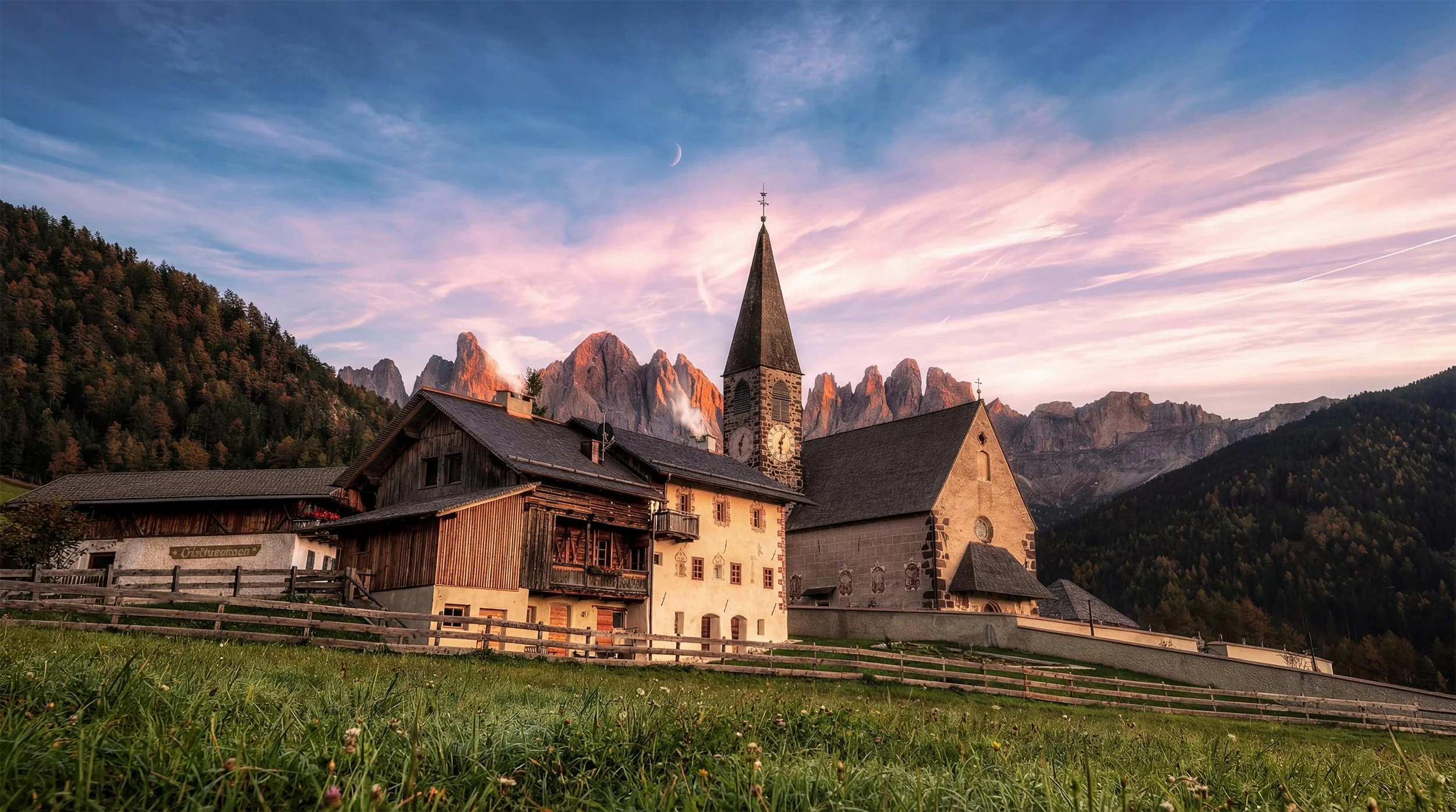
The last light catches the Odle mountains behind Santa Maddalena as a crescent moon appears above Val di Funes.
Stay in Santa Maddalena, Not Somewhere an Hour Away
This is one of the biggest pieces of advice I can give a photographer.
Stay where you want to photograph.
Saving a little money by staying elsewhere and then driving into Val di Funes every morning defeats much of the purpose.
When you’re based in Santa Maddalena, you can look out the window, see what’s happening to the peaks and react.
You’re also there after the day visitors leave.
Where to Stay in Val di Funes
For a higher-end stay, Hotel Tyrol Dolomitesslowliving is superbly positioned in Santa Maddalena. If photography is the reason you’re coming, I’d be looking for a room facing the mountains.
Hotel & Restaurant Fines is another extremely convenient option in Santa Maddalena and has the considerable advantage of having a restaurant right there. After chasing light until dark, the last thing I want is another expedition to find dinner.
For more of a traditional South Tyrolean farm-stay experience, look at accommodation around Santa Maddalena such as Proihof and Fallerhof. The important thing for me isn’t luxury. It’s location.
Can I walk out the door with my camera and be where I need to be?
Photographing Santa Maddalena
You’ve probably seen this view before you’ve even heard the name Val di Funes.
Santa Maddalena sits among rolling meadows with the Odle mountains exploding out of the landscape behind it.
But don’t just hunt for the exact composition you’ve seen on Instagram.
Walk.
Explore the panoramic paths above the village. Small changes in elevation completely alter the relationship between the church, farms, forest and mountains.
More importantly, return more than once.
Cloud, fog, snow and light can turn essentially the same composition into completely different photographs.
That’s why I stay rather than visit.
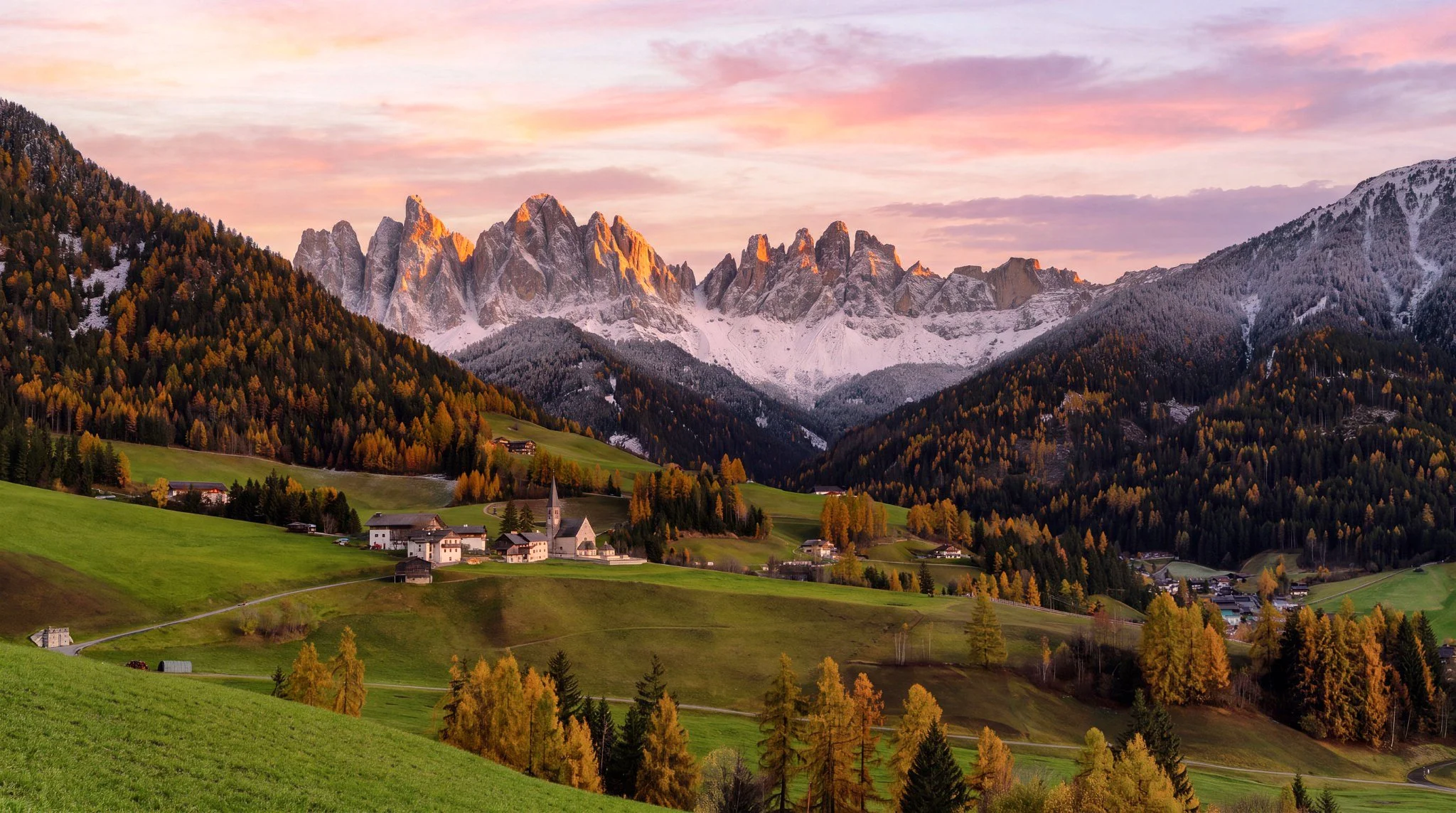
Late autumn in Val di Funes, when golden larches and green meadows meet the first snow of winter across the Odle mountains.
San Giovanni in Ranui
The tiny Church of St. Johann in Ranui beneath the Odle peaks is probably the valley’s most recognisable composition.
It’s also where photographers need to behave themselves.
The chapel sits amid private farmland. Stick to designated access and viewpoints, respect fences and don’t walk through meadows simply because you’ve found a slightly better foreground.
The photograph isn’t worth damaging someone’s land or making life miserable for the people who actually live here.
And there are plenty of compositions without doing it.
My Favourite Conditions
Blue skies are lovely for travelling.
They’re rarely what I’m hoping for as a landscape photographer.
Give me rapidly changing weather in Val di Funes.
One of the great pleasures here is watching cloud interact with the Odle. Peaks appear, disappear and then suddenly catch light through a gap you didn’t even realise was developing.
That’s when patience becomes more important than equipment.
Don’t pack the camera because sunset appears to be over.
Some of the most interesting light can happen when you think nothing is going to happen at all.
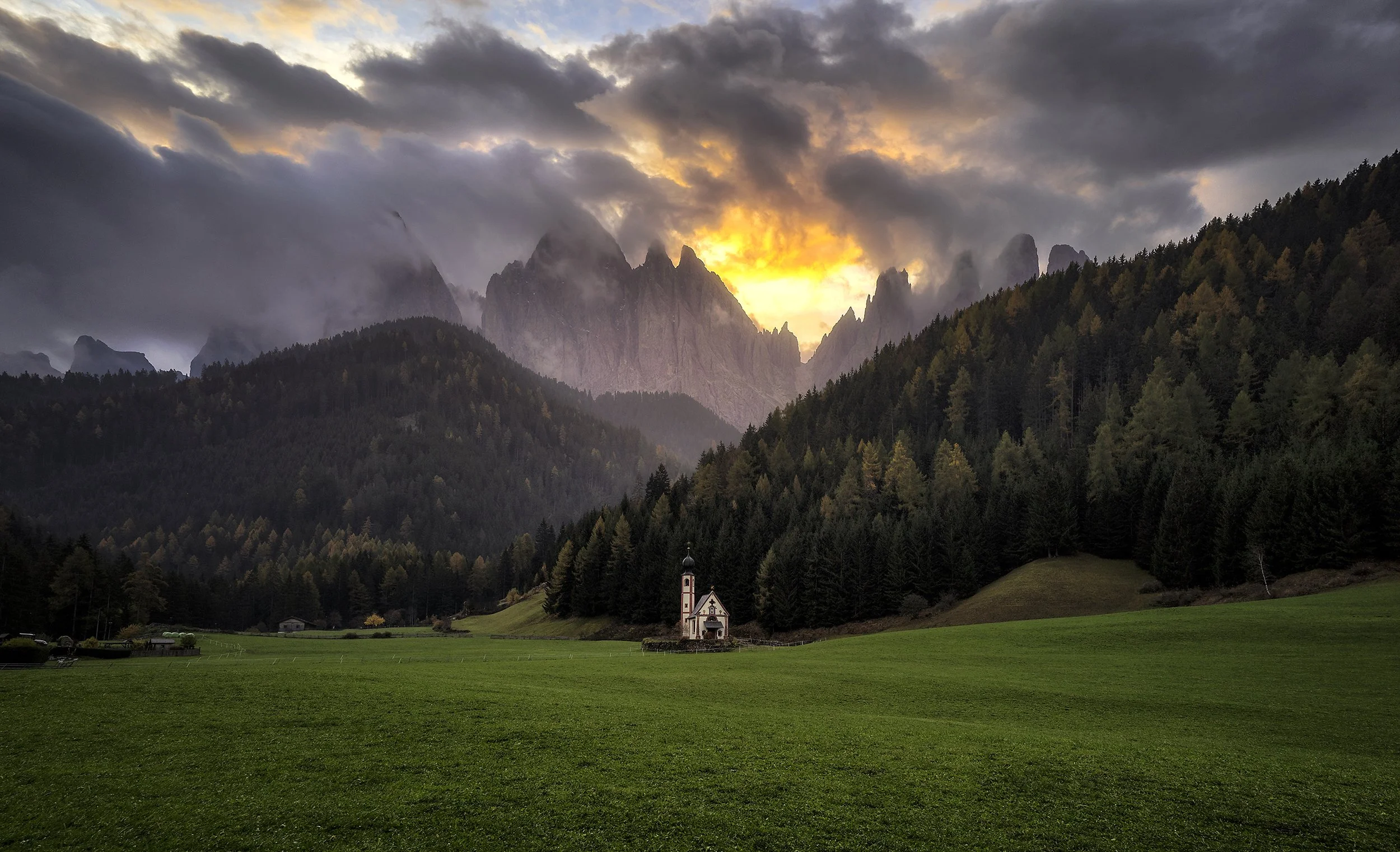
Storm light breaks through the Odle mountains above San Giovanni in Ranui, Val di Funes.
Get Up Into the Mountains
Don’t spend three days photographing churches.
Val di Funes is also a gateway to the Puez-Odle Nature Park.
The Adolf Munkel Trail takes you beneath the north faces of the Odle and is one of the classic walks in this part of the Dolomites.
And if you’re carrying a camera, you’re going to stop.
A lot.
One of the rewards is reaching Geisler Alm, where you can eat beneath one of the most ridiculous mountain backdrops in Europe.
It’s exactly the sort of mountain stop I love. South Tyrolean food, something warm to drink and the Odle sitting directly in front of you.
Always check seasonal opening dates before heading into the mountains, particularly if you’re travelling in late autumn or early winter.
Where to Eat and Drink
This is another reason not to treat Val di Funes as a photography drive-through.
South Tyrol has a wonderful collision of Italian and Austrian influences. Expect dumplings, speck, pasta, polenta, goulash, mountain cheeses and the sort of food that makes considerably more sense after spending several hours outside in freezing weather.
In Santa Maddalena, Hotel & Restaurant Fines is incredibly convenient when you’ve stayed outside photographing until the last light disappears.
Up in the mountains, Geisler Alm combines lunch or coffee with one of the great views of the Odle.
Down the valley in San Pietro, Viel Nois is another place worth knowing about for food, drinks and accommodation.
But cafés and restaurants are also part of slowing the whole trip down.
Don’t spend every daylight hour racing between GPS coordinates.
Have coffee. Eat lunch. Talk to people.
Photography becomes much more interesting when the trip stops being entirely about photography.
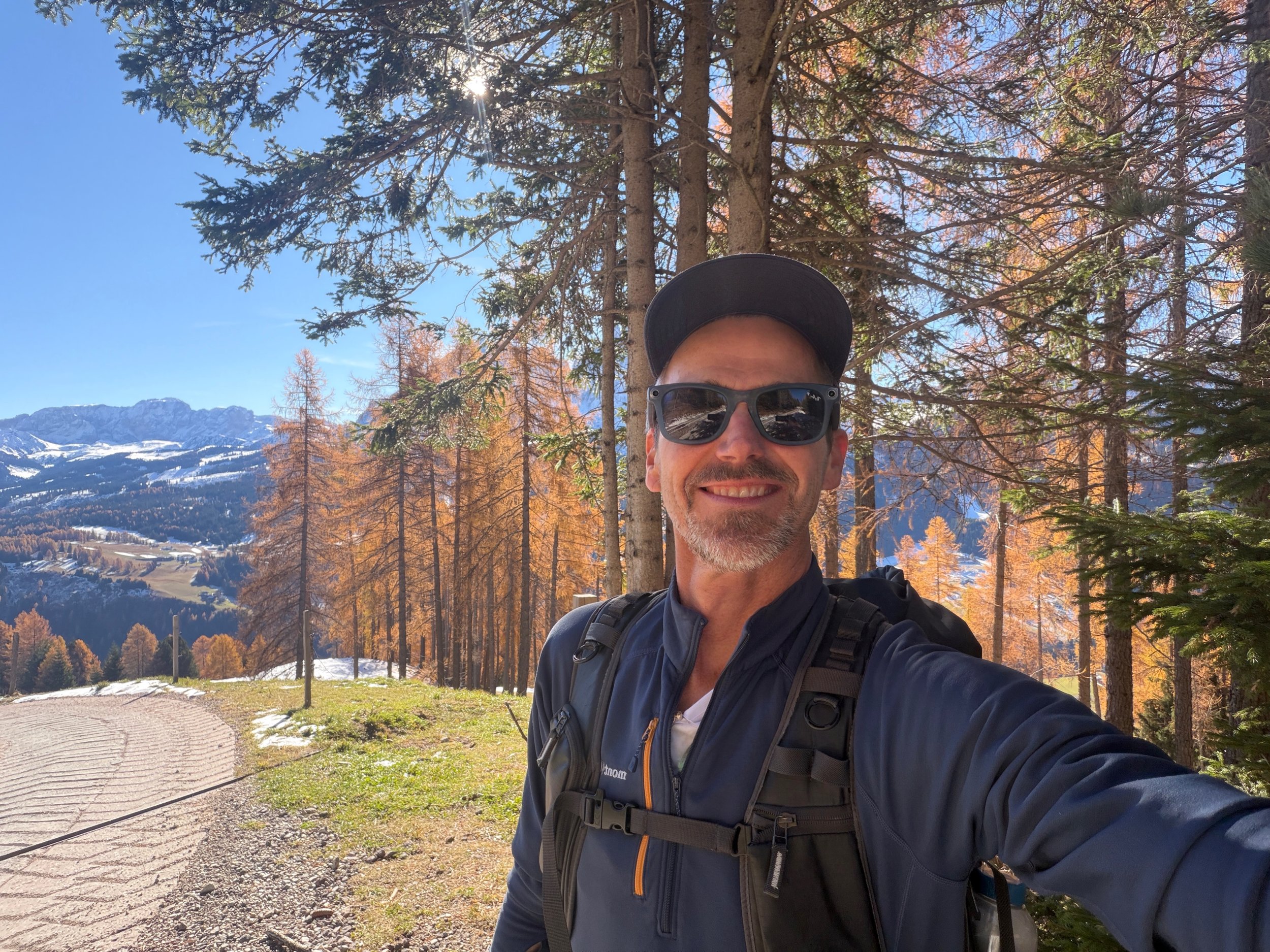
Out exploring the Dolomites during that brief transition when autumn colour meets the first snow of winter.
Don’t Arrive, Photograph and Leave
This is probably the most important part of this guide.
Social media has taught us to consume landscapes.
Arrive at the coordinates. Take the photograph. Post it. Move on.
Val di Funes deserves better than that.
Stay for several days and walk the same roads. Buy coffee from the same places. Say buongiorno or Guten Morgen. Let people see you more than once.
Eventually you’re no longer simply observing the valley from behind a camera.
You’re sitting somewhere with a coffee while somebody remembers you from yesterday. You’re watching tractors move through the fields. You’re noticing which houses catch the first sunlight. You’re recognising the sound of church bells rather than treating the church simply as a foreground element.
That’s when a famous photography location starts becoming a place.
Respect the People Who Live Here
Val di Funes is someone’s home.
Those perfect green meadows aren’t props. They’re working farmland.
The little roads aren’t there to provide leading lines.
The churches aren’t photography sets.
And the houses aren’t part of an open-air museum.
Use designated parking. Stay on paths. Don’t climb fences. Check local regulations before flying a drone. Don’t block roads with tripods.
And don’t be an idiot.
It’s amazing how quickly people warm to photographers when photographers behave like normal human beings.
How Long Do You Need in Val di Funes?
One day: You’ll get the photograph.
Two nights: You’ll begin to understand the place.
Three to four nights: This is what I recommend.
It gives you several attempts at sunrise and sunset, time for the mountains, a proper walk, long lunches and enough breathing room that you aren’t constantly watching the clock.
If conditions turn bad, don’t immediately leave.
Bad weather in the Dolomites has a habit of becoming very good photography.
What Camera Gear Would I Bring?
I don’t think Val di Funes requires an enormous amount of equipment.
For the classic landscapes, something around 24-70mm or 24-105mm will cover a surprising amount.
A 16-35mm is useful when you get closer to the mountains, while a longer lens allows you to compress layers and isolate sections of the Odle.
More important than carrying every lens you own is having the camera with you when the light changes.
A tripod remains worthwhile for blue hour, poor weather and longer exposures.
And bring proper waterproof clothing.
You can protect a camera remarkably easily.
A cold, wet photographer becomes miserable surprisingly quickly.
Val di Funes Beyond Instagram
My favourite thing about Val di Funes isn’t actually a particular viewpoint.
It’s what happens when the viewpoint stops being the reason you’re there.
After the crowds thin, autumn gives way to early winter and the valley settles back into something resembling normal life, Val di Funes becomes extraordinarily peaceful.
You begin recognising people.
They begin recognising you.
And once everyone has established that you’re not some lunatic roaming around their village with a camera, conversations start.
That’s when I think you really begin to experience this place.
Come for the extraordinary photographs.
But stay long enough that you occasionally forget to take one.
That is how I think Val di Funes should be experienced.
Planning a Photography Trip to the Dolomites?
Val di Funes is only one part of an enormous photographic landscape. I’ll be adding more of my personal guides to photographing the Dolomites, including locations, accommodation, seasonal advice and what I’ve learned from returning to these landscapes over the years.
If photography is your reason for travelling, my biggest piece of advice is simple:
Stop trying to see everything.
Choose fewer places. Stay longer. Wait for the light.
And give yourself enough time for somewhere beautiful to become something more than a photograph.
Photography and words by Timothy Poulton.